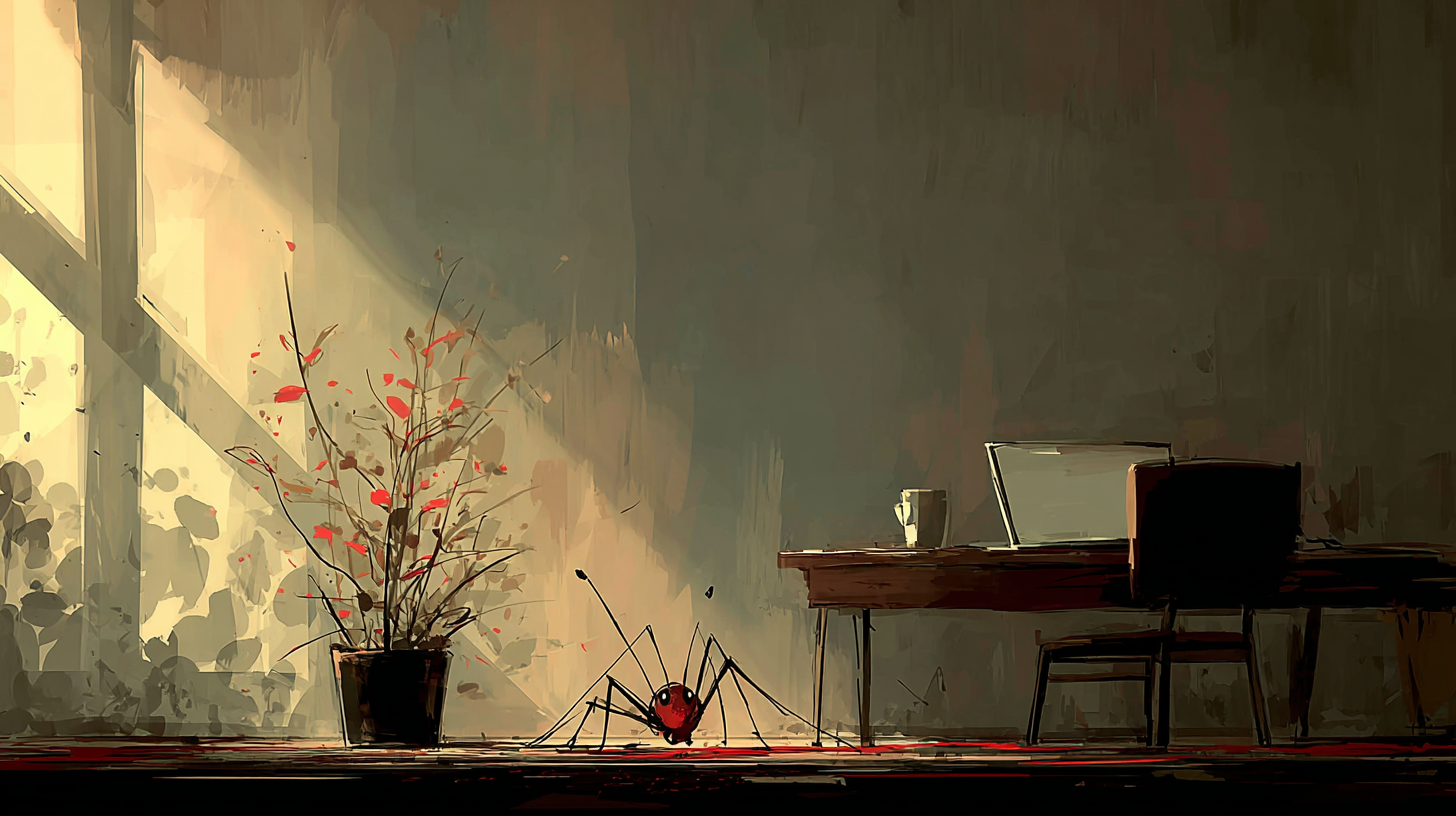
An insect is a small bug with six legs.
insect は「6本足の小さな虫(昆虫)」のこと。
以下は英単語 “insect” に関するストーリー型学習コンテンツです。まずは大枠の意味を理解して最後の文章で確認しましょう。
「insect」の主な意味(main meaning)
| 品詞 | 主要な意味 | 英語定義(簡潔) | 英語例文(1文) | 発音記号(IPA) |
|---|---|---|---|---|
| noun | 昆虫 | A small animal with six legs and a body in three parts, often with wings. | An insect landed on my desk while I was working. | /ˈɪn.sekt/ |
「insect」の語源(etymology)
ラテン語の「insectum(切り分けられたもの)」がもとで、体がいくつかの部分に分かれて見えることから来ています。
核となるイメージは「体がいくつかの節に分かれた、小さくて動く生き物」です。
「insect」の類義語(synonyms)
| 類義語 | 基本的な意味 | 指定単語とのニュアンスの違い | 英語例文 |
|---|---|---|---|
| bug | 虫(くだけた言い方) | insect より会話でよく使う。正確さより「虫だ」くらいの感じ。 | There’s a bug in the kitchen. |
| beetle | 甲虫(カブトムシやテントウムシ系) | insect の中の一種類をはっきり指す。具体的で細かい。 | A beetle crawled under the notebook. |
| critter | 小さな生き物(くだけた言い方) | 虫に限らず小動物にも使う。少しやさしい・かわいい響き。 | A little critter was hiding near the plant. |
| pest | 害虫 | insect に「困る存在」というマイナス感が強く加わる。 | Mosquitoes are a pest in summer. |
| arthropod | 節足動物(科学的) | insect より広い。昆虫以外(クモなど)も含みうる硬めの言い方。 | The report mentions arthropods found in the storage room. |
「insect」の反義語(antonyms)
| 反義語 | 基本的な意味 | 英語例文 |
|---|---|---|
| vertebrate | 脊椎動物 | A fish is a vertebrate, unlike an insect. |
| mammal | 哺乳類 | Humans are mammals, not insects. |
「insect」のコロケーション(collocations)
| コロケーション | 意味 | 英語例文 |
|---|---|---|
| insect bite | 虫さされ | I got an insect bite during lunch outside. |
| insect repellent | 虫よけ | Keep insect repellent in the first-aid kit. |
| insect species | 昆虫の種類 | The guide explains each insect species in the area. |
| insect population | 昆虫の数(個体数) | The insect population increases after heavy rain. |
| insect larvae | 昆虫の幼虫 | We found insect larvae near the sink. |
「insect」の2項表現(binomials)
| 2項表現(A and B) | 意味 | 英語例文 |
|---|---|---|
| flies and mosquitoes | ハエと蚊 | In summer, we see flies and mosquitoes near the windows. |
| ants and bees | アリとハチ | The garden attracts ants and bees in the morning. |
英語ストーリー(english story)
On Thursday morning, I arrived at the office earlier than usual because we had a visitor from our head office. I wanted the meeting room to look perfect. I wiped the table, checked the projector, and opened the blinds to let in fresh light.
While I was placing water bottles on the side table, something small moved near my laptop. At first, I thought it was just dust, but it crawled in a straight line. I leaned closer and saw an insect with shiny wings. “Please don’t do this today,” I whispered.
My coworker Mika walked in with a stack of documents. “What’s wrong?” she asked.
“There’s an insect on the desk,” I said, trying to stay calm.
Mika smiled. “Oh, just a bug. Put a cup over it and slide paper under it.”
I did as she said, but the little creature didn’t panic. It moved slowly, like it had a plan. When I finally guided it into the cup, I could see its shape better. “This looks like a beetle,” I said.
Mika raised her eyebrows. “A beetle? In our office?”
“Maybe it came in with a delivery box,” I said. “Or from the plant near the window.”
Mika looked around the room. “We should check the corner with the indoor plant. Sometimes a small critter hides there.”
We walked to the window area. The plant was healthy, but there were tiny marks in the soil. I felt a sudden worry. The last thing we needed was a bigger problem right before an important meeting.
Ken from facilities came in to test the air conditioner. I told him what we found and showed him the cup. He laughed softly. “It happens. But if you see more, it could become a pest issue.”
“A pest issue?” Mika repeated, sounding less cheerful.
Ken nodded. “One insect is not a crisis. But if there are many, it can affect cleanliness and comfort. Also, some people are sensitive. An insect bite can distract someone all day.”
As if the office wanted to prove his point, Mika scratched her arm. “I got an itchy spot yesterday. Maybe it was an insect bite,” she said. “I thought it was just dry skin.”
Ken opened his toolbox and took out a small flashlight. “Let’s do a quick check. If we find signs of insect larvae, we should call the cleaning company for a deeper inspection.”
We inspected the window frame, the plant pot, and the storage shelf where extra stationery was kept. In a small gap behind a box, Ken pointed at a few pale shapes. “These might be insect larvae,” he said. “Not sure yet, but we should treat it carefully.”
Mika’s face tightened. “So it might not be only one.”
Ken stayed calm. “No need to panic. We can handle it. First, remove food from open areas. Second, seal the gap near the window. Third, we can use safe measures. Do you have insect repellent?”
“We have some in the emergency drawer,” I said. “But I thought insect repellent was only for outdoor trips.”
Ken smiled. “It’s useful in offices too, especially near entry points. And we should document what we find. Our health and safety report likes clear terms. If we need to be technical, we can say ‘arthropod’ activity, but we should confirm the insect species first.”
Mika laughed a little. “Arthropod sounds like a robot.”
Ken chuckled. “It’s just a scientific word. The point is to identify what we’re dealing with. Different insect species need different solutions.”
We cleaned the area, sealed the gap with tape for the day, and moved the plant slightly away from the window. Ken wrote a note to schedule a proper inspection after the meeting. I disposed of the beetle outside, far from the entrance.
By noon, the meeting room looked spotless. The visitor arrived, and the presentation went smoothly. During a short break, the visitor mentioned how comfortable the room felt. I almost laughed, thinking about how close we were to chaos.
After the visitor left, Mika and I returned to our desks. She said, “You know, when I hear ‘insect,’ I imagine flies and mosquitoes, not a beetle in a meeting room.”
I nodded. “Me too. But today reminded me that nature doesn’t care about our schedule.”
Mika looked at the window and added, “And outside, there are ants and bees doing their own work. We just need to do ours.”
Ken passed by and gave a thumbs-up. “Good teamwork,” he said. “We’ll keep an eye on the insect population around the windows this month.”
I sat down, finally relaxed. The office was quiet again, and I felt proud that we solved the problem without making it a drama.
和訳
木曜の朝、私は本社からの来客があるので、いつもより早くオフィスに着いた。会議室を完璧に見せたかった。机を拭き、プロジェクターを確認し、ブラインドを開けて光を入れた。
横のテーブルに水のボトルを並べていると、ノートパソコンの近くで小さなものが動いた。最初はほこりだと思ったが、まっすぐ進んでいた。近づいて見ると、つやのある羽のある昆虫(insect:昆虫)がいた。「今日だけはやめて」と私は小声で言った。
同僚のミカが書類の束を持って入ってきた。「どうしたの」と彼女が聞いた。
「机の上に昆虫(insect:昆虫)がいる」と私は落ち着こうとしながら言った。
ミカは笑った。「ああ、ただの虫(bug:虫)だよ。コップをかぶせて、紙を下に滑り込ませればいい。」
私は言われた通りにしたが、その小さな生き物は慌てなかった。まるで計画があるみたいにゆっくり動いた。やっとコップの中に誘導すると形がよく見えた。「これ、甲虫(beetle:甲虫)っぽい」と私は言った。
ミカは眉を上げた。「甲虫(beetle:甲虫)がオフィスに?」
「配送の箱と一緒に入ったのかも」と私は言った。「それか窓の近くの植物から。」
ミカは部屋を見回した。「窓際の観葉植物のところを確認しよう。ときどき小さな生き物(critter:小さな生き物)が隠れているから。」
私たちは窓際へ歩いた。植物は元気そうだったが、土に小さな跡があった。重要な会議の直前に、もっと大きな問題になったら困ると思って不安になった。
設備担当のケンがエアコンの確認に入ってきた。私たちは見つけたことを伝え、コップを見せた。彼はやさしく笑った。「あるよ。でも複数いるなら、害虫(pest:害虫)の問題になるかもしれない。」
「害虫(pest:害虫)の問題?」ミカは明るさが消えた声で言った。
ケンはうなずいた。「昆虫(insect:昆虫)が一匹なら危機じゃない。でも数が増えると、清潔さや快適さに影響が出る。人によっては敏感だしね。虫さされ(insect bite:虫さされ)は一日中集中を切らす原因になる。」
まるで彼の言葉を証明するように、ミカは腕をかいた。「昨日かゆいところがあった。虫さされ(insect bite:虫さされ)だったのかも。乾燥だと思ってた。」
ケンは工具箱から小さなライトを出した。「簡単に点検しよう。もし昆虫の幼虫(insect larvae:昆虫の幼虫)の痕跡があれば、清掃会社に詳しい確認を頼むべきだ。」
私たちは窓枠、植木鉢、文房具を置いている棚を調べた。箱の後ろの小さなすき間で、ケンが薄い色の形を指した。「これは昆虫の幼虫(insect larvae:昆虫の幼虫)かもしれない。まだ確実じゃないけど、慎重に扱おう。」
ミカの表情が固まった。「じゃあ、一匹だけじゃないかも。」
ケンは落ち着いていた。「慌てなくていい。対応できる。まず、開いた場所に食べ物を置かない。次に、窓の近くのすき間をふさぐ。それから安全な方法を使う。虫よけ(insect repellent:虫よけ)はある?」
「非常用の引き出しにある」と私は言った。「でも虫よけ(insect repellent:虫よけ)って外出用だと思ってた。」
ケンは笑った。「オフィスでも役立つよ。特に入り口になりやすい場所の近くでね。それに、見つけたことを記録しよう。健康と安全の報告書ははっきりした言葉が好きだ。技術的に言うなら節足動物(arthropod:節足動物)の活動と言えるけど、まずは昆虫の種類(insect species:昆虫の種類)を確認しないと。」
ミカは少し笑った。「節足動物(arthropod:節足動物)ってロボットみたい。」
ケンはくすっと笑った。「ただの科学用語だよ。大事なのは相手を特定すること。昆虫の種類(insect species:昆虫の種類)によって対策が違う。」
私たちはその周辺を掃除し、その日はテープで隙間をふさぎ、植物を窓から少し離した。ケンは会議の後に正式な点検を入れるようメモを書いた。私は甲虫(beetle:甲虫)を入口から遠い外へ逃がした。
昼には会議室は完全にきれいになった。来客が到着し、プレゼンは順調に進んだ。休憩中、来客が部屋の快適さを褒めた。私は混乱寸前だったことを思い出して、笑いそうになった。
来客が帰った後、ミカと私は席に戻った。彼女は言った。「昆虫(insect:昆虫)って聞くと、私はハエと蚊(flies and mosquitoes:ハエと蚊)を思い浮かべる。会議室の甲虫(beetle:甲虫)じゃなくてね。」
私はうなずいた。「私も。でも今日で分かった。自然は私たちの予定なんて気にしない。」
ミカは窓を見て付け加えた。「外ではアリとハチ(ants and bees:アリとハチ)がそれぞれの仕事をしてる。私たちも自分の仕事をするだけだね。」
ケンが通りかかって親指を立てた。「いいチームワークだった」と言った。「今月は窓まわりの昆虫の数(insect population:昆虫の数)に気をつけよう。」
私は座って、ようやく落ち着いた。オフィスはまた静かになり、大ごとにせず解決できたことが誇らしかった。
「insect」のQ&A
- Qinsect は bug とどう違いますか
- A
insect は「昆虫」を正確に言う言葉で、bug は会話で「虫」とざっくり言う言い方です
- Qpest は insect と同じですか
- A
pest は insect の中でも人にとって迷惑な「害虫」という意味が強いです
- Qbeetle は insect の一種ですか
- A
beetle は insect の中の一種類で、甲虫の仲間をはっきり指します
- Qcritter は insect だけに使いますか
- A
critter は虫に限らず小さな生き物全般に使えて、少しやさしい響きがあります
- Qarthropod は insect より広い意味ですか
- A
arthropod は節足動物のことで、昆虫以外も含みうるので insect より広い言葉です
- Qinsect bite はどんな意味ですか
- A
insect bite は「虫さされ」のことで、蚊などに刺されたときによく使います
- Qinsect repellent はどう使いますか
- A
insect repellent は「虫よけ」で、肌や服に使って虫を近づけにくくします
- Qinsect species は何を表しますか
- A
insect species は「昆虫の種類」を表し、どの昆虫かを分類して言うときに使います
- Qinsect larvae は何ですか
- A
insect larvae は「昆虫の幼虫」で、成虫になる前の段階を指します
- Qflies and mosquitoes や ants and bees はどんな場面で使えますか
- A
どちらも A and B で生き物を並べて言う自然な形で、身近な例をまとめて話したいときに使えます


コメント