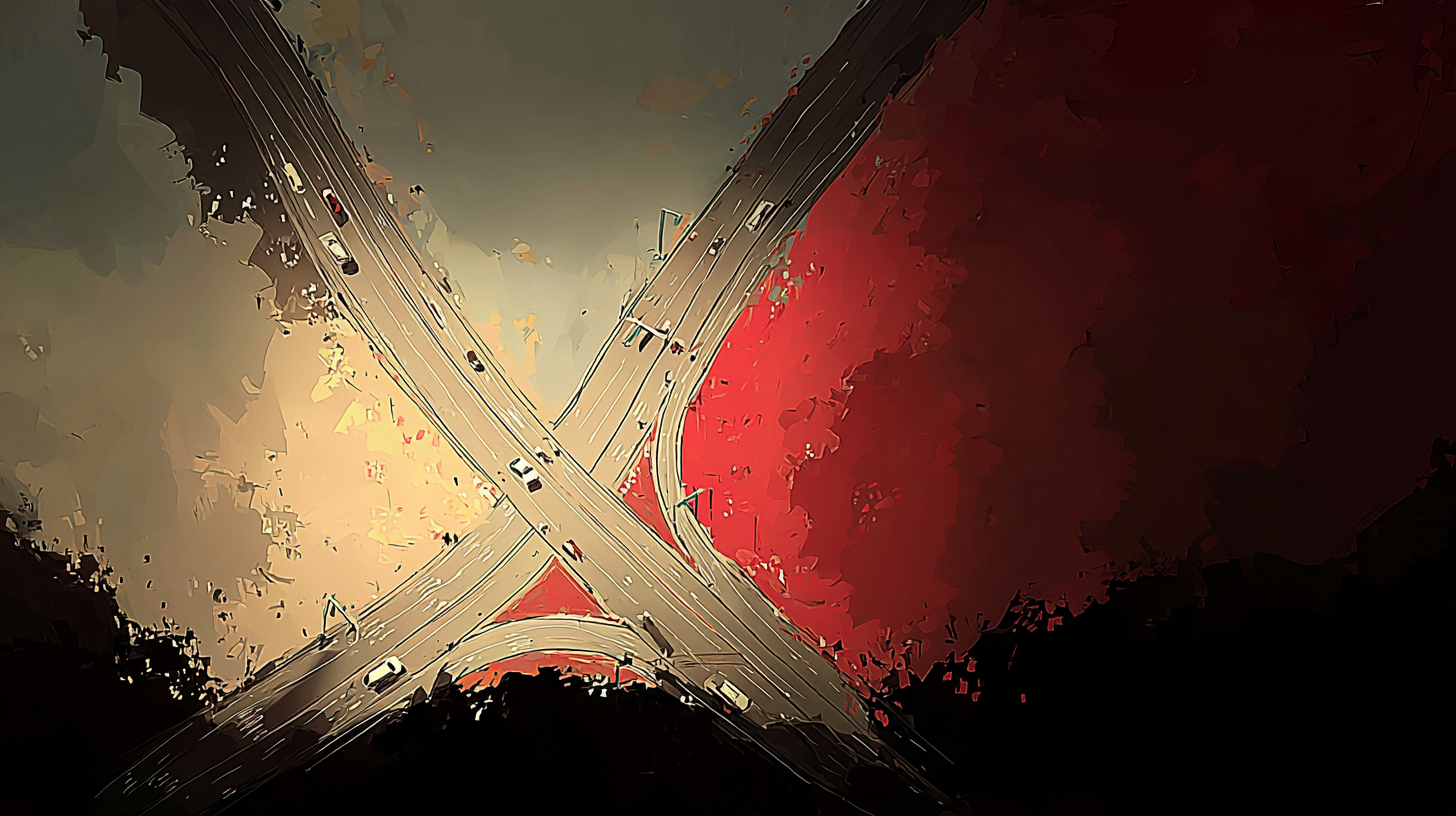
An intersection is where roads meet, or where two things meet and overlap.
intersectionは、道が交わる交差点や、二つのものが重なるところのこと。
以下は英単語 “intersection” に関するストーリー型学習コンテンツです。まずは大枠の意味を理解して最後の文章で確認しましょう。
「intersection」の主な意味(main meaning)
| 品詞 | 意味 | 英語定義(簡潔) | 英語例文(1文) | 発音記号(IPA) |
|---|---|---|---|---|
| noun | 道路の交差点 | a place where two or more roads meet or cross | There was a long line of cars at the intersection. | /ˌɪn.tɚˈsek.ʃən/ |
| noun | 重なり合う部分 交わる点 | a point or area where two things meet and share common parts | This project sits at the intersection of design and technology. | /ˌɪn.tɚˈsek.ʃən/ |
「intersection」の語源(etymology)
ラテン語の inter(間に)+ secare(切る)がもとです。
核となるイメージは「線を間で切って交わらせる」で、道や考えが交わる場面を思い浮かべると覚えやすいです。
「intersection」の類義語(synonyms)
| 類義語 | 基本的な意味 | 指定単語とのニュアンスの違い(中学生にもわかる日本語) | 英語例文 |
|---|---|---|---|
| crossing | 横断する場所 交差する場所 | 道や線が「交わる」ことに注目。交差点だけでなく川の横断地点などにも使う。 | Be careful at the crossing near the station. |
| junction | 接続点 分かれ道 | 道路がつながる「つなぎ目」の感じ。交差というより合流や分岐にもよく使う。 | Turn left at the next junction. |
| crossroads | 交差点 分かれ道 | 道が交わる場所だが、比喩で「重要な選択の場面」にもよく使う。 | Our team is at a crossroads after the merger. |
| overlap | 重なり | 「重なる部分」に焦点。道路より、仕事の範囲や時間がかぶる話でよく使う。 | There is an overlap between these two tasks. |
| convergence | 集まって一つになること | 複数が「集まって近づく」感じ。交通や意見が一つに向かう場面で使う。 | The convergence of ideas made the plan stronger. |
「intersection」の反義語(antonyms)
| 反義語 | 基本的な意味 | 英語例文 |
|---|---|---|
| separation | 分離 離れること | The separation of duties helps prevent mistakes. |
| divergence | 分岐 それぞれ別の方向へ進むこと | The divergence in opinions slowed the decision. |
「intersection」のコロケーション(collocations)
| コロケーション | 意味 | 英語例文 |
|---|---|---|
| a busy intersection | 混雑した交差点 | A busy intersection needs clear signals. |
| a traffic intersection | 交通の交差点 | The city plans to redesign the traffic intersection. |
| at the intersection of A and B | AとBの交わるところで | She works at the intersection of sales and data. |
| the intersection of A and B | AとBの共通部分 交点 | The intersection of speed and safety is our focus. |
| intersection point | 交点 交わる点 | Mark the intersection point on the map. |
「intersection」の2項表現(binomials)
| 2項表現(A and B) | 意味 | 英語例文 |
|---|---|---|
| pros and cons | 良い点と悪い点 | Let’s list the pros and cons before we choose. |
| rules and regulations | 規則と規定 | Please follow the rules and regulations in the lab. |
| stop and go | 止まって進むの繰り返し | The traffic was stop and go all morning. |
英語ストーリー(english story)
On Monday morning, I arrived at our office earlier than usual because the traffic was stop and go near the busy intersection outside the station. Our company, GreenLine Logistics, was planning a new delivery route, and my team had to finish the proposal by the end of the day.
When I walked into the meeting room, my manager, Ms. Tanaka, was already there with a city map on the screen. “Today we need to find the safest and fastest route,” she said. “This is not only about speed. It’s also about health and safety, so please think carefully.”
Ken, from operations, pointed at a traffic intersection in the center of the map. “This junction is always crowded,” he said. “Trucks lose time here. If we avoid it, we can save at least ten minutes.”
I leaned forward. “I agree it’s a problem,” I said, “but that intersection is also the main crossing for our drivers who pick up packages from the post office. If we remove it, we might create confusion.”
Ms. Tanaka nodded. “Good point. Let’s examine the pros and cons. Ken, tell us why you want to change it. And Aya, explain the risks.”
Ken showed some data on his laptop. “Over the last month, we saw a clear convergence of delays around this area,” he said. “Many small issues come together at this one point. If we choose a different route, the delays will spread out, and that’s better.”
“Spread out,” I repeated. “You mean a kind of divergence?”
“Exactly,” Ken said. “Instead of one big bottleneck, we get several smaller ones.”
I opened my notes. “But we also need to think about driver training,” I said. “Our new drivers learn the city by landmarks. This intersection is an easy landmark. If we avoid it, we may need extra training time, and that is a cost.”
Ms. Tanaka wrote on the whiteboard: Time, Safety, Training, Cost. “We’re at a crossroads,” she said with a small smile. “Not a real one, but a business one.”
Everyone laughed, and the atmosphere became lighter.
Then Rina from HR raised her hand. “Can I add something?” she asked. “There is also an overlap between this route project and our new safety policy. The policy says drivers must avoid narrow streets during peak hours. If we change the route, we must check the rules and regulations and update the handbook.”
That reminded me of an email I had read. “Right,” I said. “And the new policy is strict about turning at certain corners. Some turns are risky because the view is blocked.”
Ms. Tanaka switched to a zoomed-in map. “Let’s look at the intersection point where the route meets the school zone,” she said. “This is where accidents have happened before.”
Ken looked surprised. “I didn’t notice that,” he admitted.
“It’s the intersection of speed and safety,” Ms. Tanaka said. “We can’t only chase speed.”
We spent the next thirty minutes checking accident reports and delivery records. The more we looked, the clearer it became that the problem was not just one intersection. It was the intersection of planning and reality. On paper, a route could be perfect, but in real life, a single parked car could block a lane.
Finally, Ms. Tanaka asked me to propose a compromise. I took a breath. “What if we keep the main intersection in the morning,” I said, “because it’s the simplest crossing for new drivers, but we avoid it in the afternoon when the crowd is worse? We can set a time-based rule in the app.”
Ken considered it. “That could work,” he said. “We reduce delays during the worst hours without changing everything.”
Rina added, “And we can update the handbook with clear instructions. If it’s written well, training will be easier.”
Ms. Tanaka smiled. “I like it. It respects the pros and cons and fits our rules and regulations. Also, it places us at the intersection of efficiency and responsibility.”
By the end of the meeting, we had a plan: a flexible route with clear time windows, plus a short training video that explained the key turns and the school zone. When I returned to my desk, I felt relieved. We had started with disagreement, almost a separation of ideas, but we ended with a shared solution.
As I looked out the window, I could see the distant intersection near the station. Cars flowed through it in steady waves. It reminded me that an intersection is not only where roads meet. It is also where people’s thoughts meet, and where a team learns how to move forward together.
和訳
月曜日の朝、駅の外の混雑した交差点(busy intersection:混雑した交差点)の近くで、交通が止まって進むの繰り返し(stop and go:止まって進むの繰り返し)だったので、私はいつもより早くオフィスに着いた。私たちの会社GreenLine Logisticsは新しい配送ルートを計画していて、私のチームはその日中に提案を完成させる必要があった。
会議室に入ると、マネージャーの田中さんが地図を画面に映して待っていた。「今日は一番安全で一番速いルートを見つけたい」と彼女は言った。「これは速度だけの話ではありません。健康と安全(health and safety:健康と安全)にも関わるので、よく考えてください。」
運用担当のケンが、地図の中央にある交通の交差点(traffic intersection:交通の交差点)を指さした。「このジャンクション(junction:接続点)はいつも混んでいます」と彼は言った。「トラックはここで時間を失います。避けられれば、少なくとも10分は短くできます。」
私は身を乗り出した。「問題なのは同意します」と言い、「でもそのインターセクションは、郵便局で荷物を受け取るドライバーにとって主要な横断地点(crossing:横断する場所)でもあります。外すと混乱が起きるかもしれません。」
田中さんはうなずいた。「いい指摘です。良い点と悪い点(pros and cons:良い点と悪い点)を見ましょう。ケンは変えたい理由を、アヤはリスクを説明して。」
ケンはノートPCでデータを見せた。「この1か月、この周辺で遅れが集まる動き(convergence:集まって一つになること)がはっきりあります」と言った。「小さな問題がここ一点に集まっています。別ルートなら遅れが分散し、それが良いです。」
「分散」と私は繰り返した。「つまり分岐(divergence:分岐)みたいにするってこと?」
「その通り」とケンは言った。「大きな渋滞1つより、小さなものがいくつかの方がましです。」
私はメモを開いた。「でも運転研修も考える必要があります」と言った。「新人は目印で街を覚えます。このインターセクションは分かりやすい目印です。避けるなら研修時間が増え、コストになります。」
田中さんはホワイトボードに、時間、安全、研修、コストと書いた。「私たちは分かれ道(crossroads:重要な選択の場面)にいますね」と少し笑って言った。「本物の交差点ではないけれど、ビジネス上の分かれ道です。」
みんなが笑い、空気が軽くなった。
するとHRのリナが手を挙げた。「付け加えていいですか」と言った。「このルート計画と新しい安全方針には重なり(overlap:重なり)があります。方針では、ピーク時間は狭い道を避けることになっています。ルートを変えるなら、規則と規定(rules and regulations:規則と規定)を確認して、手引きを更新しないといけません。」
それで私は、読んだばかりのメールを思い出した。「そうですね」と言った。「新方針は特定の曲がり角で厳しいです。見通しが悪い曲がり方は危険です。」
田中さんは地図を拡大した。「ルートがスクールゾーンと交わる交点(intersection point:交点)を見ましょう」と言った。「ここは以前事故が起きています。」
ケンは驚いた顔をした。「気づきませんでした」と認めた。
「速度と安全の交わるところ(the intersection of A and B:AとBの共通部分)ですね」と田中さんは言った。「速度だけを追いかけられません。」
私たちは次の30分、事故報告と配送記録を確認した。見れば見るほど、問題は交差点1つだけではないと分かった。紙の上の計画と現実の交わるところ(at the intersection of A and B:AとBの交わるところ)だった。紙の上では完璧でも、現実では1台の駐車車両で車線がふさがることがある。
最後に田中さんが、私に妥協案を出すよう求めた。私は息を整えた。「朝は主な交差点を残しませんか」と言った。「新人にとって一番分かりやすい横断地点(crossing:横断する場所)です。でも午後は混雑がひどいので避けます。アプリに時間帯ルールを入れましょう。」
ケンは考えた。「それならいけそうです」と言った。「最悪の時間帯の遅れを減らしつつ、全部を変えずに済む。」
リナは言った。「手引きも分かりやすく更新できます。文章が良ければ研修も楽になります。」
田中さんは微笑んだ。「いいですね。良い点と悪い点(pros and cons:良い点と悪い点)を尊重し、規則と規定(rules and regulations:規則と規定)にも合います。効率と責任の交わるところ(at the intersection of A and B:AとBの交わるところ)に立てる案です。」
会議の終わりには、時間帯で切り替える柔軟なルートと、重要な曲がり角とスクールゾーンを説明する短い研修動画、という計画ができていた。自席に戻ると、私はほっとした。最初は意見が分離(separation:分離)しかけたが、最後は共通の解決策にたどり着いた。
窓の外を見ると、駅近くの遠い交差点が見えた。車が波のように流れていく。交差点は道が交わるだけではない。人の考えも交わり、チームが前に進む方法を学ぶ場所でもあるのだと思った。
「intersection」のQ&A
- Qintersectionって道路ではどういう意味?
- A
intersectionは2本以上の道が交わる交差点のことだよ。
- Qintersectionは比喩でどんな意味になる?
- A
intersectionは二つの分野や考えが交わって重なるところも表せるよ。
- Qcrossingとintersectionの違いは?
- A
crossingは横断や交わる行為や場所に注目しやすく、intersectionは交差点そのものを指しやすいよ。
- Qjunctionとintersectionの違いは?
- A
junctionは合流や分岐のつなぎ目の感じが強く、intersectionは交差して出会う点の感じが強いよ。
- Qcrossroadsはintersectionとどう違う?
- A
crossroadsは道の交差点だけでなく、人生や仕事の大事な選択の場面にもよく使うよ。
- Qoverlapはintersectionとどう使い分ける?
- A
overlapは重なっている部分の話で、intersectionは交わる点や共通部分を言いたいときに便利だよ。
- Qconvergenceはintersectionとどう関係する?
- A
convergenceは複数が一つに集まる動きで、結果として交わる点ができるイメージだよ。
- Qintersectionの反対の言い方は何?
- A
separationやdivergenceが反対に近く、離れる分かれるニュアンスだよ。
- Qintersectionのよくあるコロケーションは?
- A
a busy intersectionやat the intersection of A and Bなどがよく使われるよ。
- Qpros and consみたいなA and B表現はどう覚える?
- A
pros and consは良い点と悪い点をセットで言えて便利なので、セットで丸ごと覚えるといいよ。

コメント